








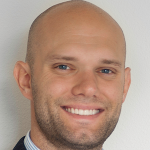

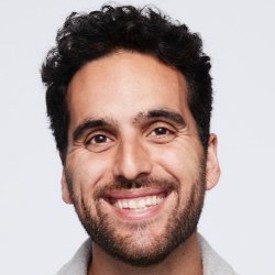
Below, Simone Stolzoff shares five key insights from his new book, How to Not Know: The Value of Uncertainty in a World that Demands Answers.
Simone is a journalist. His work has been featured in the New York Times, The Atlantic, and on the TED stage.
What’s the big idea?
You can’t control uncertainty, but you can control how you respond to it. An intentional response to the unknown is what allows growth, innovation, and opportunity.
Listen to the audio version of this Book Bite—read by Simone himself—in the Next Big Idea App, or buy the book.

1. Our brains are wired to fear uncertainty.
Picture a research study with two groups of participants. Group one was told they had a 50 percent chance of receiving a painful electric shock. Group two was told they had a 100 percent chance of receiving a painful electric shock. Who do you think would be more stressed?
You might assume group two—at least group one had a chance of getting off shock-free. But researchers from University College London found the opposite to be true. Participants who had a 50 percent chance of getting shocked felt far more stressed. It’s somehow more comfortable to expect the worst than deal with the worry of not knowing our fate.
In another study, researchers found that professional uncertainty takes a toll on our health similar to that of actually losing our job. We are biologically wired to avoid uncertainty. Think about it evolutionarily: if our ancestors heard a rustle in the bushes, but didn’t know the source of the sound, their uncertainty could have been lethal. But while avoiding uncertainty may have been adaptive in the jungle, today our discomfort with uncertainty can keep us paralyzed.
2. Find your anchors.
Certainty in some aspects of your life makes it easier to hold onto uncertainty in others. In your personal life, perhaps your anchors are a commitment to a person or a place. In your professional life, an anchor might be a commitment to your values or to serving a particular customer.
By clarifying the aspects of your business that will remain constant amidst all that is changing, you’ll be better equipped to navigate the unknown. A telling example comes from Airbnb. Brian Chesky, the founder of Airbnb, handled losing 80 percent of his business at the start of the pandemic.
Chesky knew the pandemic would be a period of unprecedented uncertainty for the company. So, one of the first things he did was create a list of six guiding principles for himself:
- Be decisive.
- Act with all stakeholders in mind.
- Preserve cash.
- Be the hero, not the villain.
- Overcommunicate.
- Win the next travel season.
“In a crisis, you have to make principle decisions, not business decisions,” he said, reflecting on what he learned from the pandemic. “A business decision is a decision you make, predicting the best possible outcome. A principle decision is irrespective of the outcome.”
Principles became Chesky’s anchors as he steered the company through an uncertain future.
3. Focus on the next right action.
In How to Not Know, I profile a crisis management expert named Meredith who gets brought into organizations when things fall apart. One particular story she told me stayed with me. A large manufacturing firm called her after there had been an accident in their factory that led to several employees getting seriously injured. When she arrived at the company headquarters, the energy among the executives was frenetic.
There was so much to do. They had to issue a press release, communicate with investors, check in with injured employees and their families, conduct safety inspections at the factory, plan when to resume production, talk to their insurance provider, and meet with current employees. The list went on and on.
“Instead of worrying about all that is unknown, we can focus on one task at a time.”
Meredith got a giant piece of butcher paper and rolled it out over the long boardroom table. One by one, she made a list of everything that needed to be done. Getting it out of the executives’ minds and onto the paper helped the team turn their tasks from amorphous anxieties into clear priorities.
When faced with uncertainty, it’s easy to be overwhelmed, but when we separate what we can and can’t control, it allows us to start making progress. Instead of worrying about all that is unknown, we can focus on one task at a time, which in Buddhism is often called “the next right action.” By taking one next right action at a time, clarity emerges through the fog.
4. Choose curiosity over fear.
One reason uncertainty can be so uncomfortable is because our brains have a natural tendency to catastrophize. It’s a hallmark psychological finding that losing something feels worse than gaining something feels good. So, our natural inclination is to brace for the worst. But while uncertainty can be scary, it is also the birthplace of possibility. Nearly every scientific discovery, world-changing business, and mind-expanding piece of art began with someone’s willingness to engage with the unknown.
In moments when we perceive uncertainty as a threat, blood flows away from our brain to our body as we prepare to either fight or flee. Yet when we see uncertainty as an opportunity to gather more information, we enter what psychologists call approach mode—our blood vessels dilate, increasing blood flow to our brain. The terminology is apt. When we see uncertainty as threatening, we retreat. But when we’re able to turn toward uncertainty, we approach a new way of thinking.
Though uncertainty can be uncomfortable, we can choose to approach what we don’t know with a sense of curiosity instead of fear. Uncertainty gives our lives texture. Without uncertainty, there would be no mystery, serendipity, or surprise. We can’t know exactly how our lives will go, and therein lies the magic.
5. Row through the fog.
In the early 2010s, the gaming startup Tiny Speck was a darling of the tech industry. The company had raised $17 million. The launch of its first game, Glitch, was covered by international media, including The Guardian and the New York Times. Within months of launching, it had tens of thousands of active players.
Despite the external signs of success, the founder had a sneaking suspicion that the company was not on the right path. So, he did something that others might’ve seen as insane. Less than two years after launch, with millions of dollars left in the bank, he decided to shut the game down.
But instead of calling it quits, the founder decided to lean into the unknown. He offered to make his investors whole, downsized the team, and, with the remaining employees, got to work on a product in an entirely different industry.
“Unless we are willing to face uncertainty head-on, we’ll never discover the possibilities awaiting us on the other side.”
While developing the game, the team had built a prototype for an internal messaging tool to help them collaborate. The founder decided to go all in on the messaging tool. That tool, Slack, became one of the fastest-growing enterprise software startups of all time. And its founder, Stuart Butterfield, was anointed as one of Silicon Valley’s most visionary entrepreneurs.
“I would love to say that we knew all the answers in advance,” Butterfield said, thinking back to his decision to shut down Glitch. “But the truth is that we discovered our product and opportunity, rather than planning for it.”
The moral of the story isn’t that all’s well that ends well, though the fact that Slack sold to Salesforce for nearly $27 billion wraps the case study up with a bow. The moral is that unless we are willing to face uncertainty head-on, we’ll never discover the possibilities awaiting us on the other side.
Butterfield’s story reminds me of a metaphor I learned while working at the design agency IDEO: being a leader is like sitting in a rowboat on a foggy lake. You can’t see far ahead or know precisely where you’ll end up, but you have two jobs: to maintain faith that you’ll eventually reach land and to keep rowing.
Enjoy our full library of Book Bites—read by the authors!—in the Next Big Idea App: