











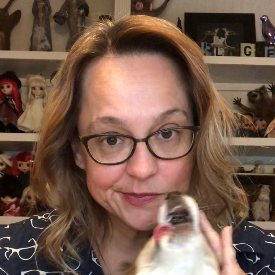
Below, Jenny Lawson shares five key insights from her new book, How to Be Okay When Nothing Is Okay: Tips and Tricks That Kept Me Alive, Happy, and Creative in Spite of Myself.
Jenny, also known as the Bloggess, is a #1 New York Times bestselling author and humorist. She is the author of Let’s Pretend This Never Happened, Furiously Happy, and Broken (in the Best Possible Way), and the proprietor of Nowhere Bookshop, an indie bookstore in San Antonio, Texas. She is best known for her dark, funny, and often unhinged writing about her life—particularly her experiences with mental illness, including depression, anxiety, ADHD, and chronic illness—topics that may not seem funny, but become far more manageable when approached with humor.
What’s the big idea?
A treasure chest of concise, simple tips and tricks that help manage the head and the heart—strategies that break through brain paralysis, make it possible to create when feeling empty, and help someone survive, and sometimes even thrive, when depression lies to us.
Listen to the audio version of this Book Bite—read by Jenny herself—in the Next Big Idea App, or buy the book.

1. Really? Just breathe?
I hate when I’m having an anxiety attack and people tell me to “just breathe” because what exactly did they think I was doing? I’m always breathing. I can literally do it in my sleep. But it turns out that there are specific breathing techniques that can slow your heart rate and lower your blood pressure so that you calm down quicker.
The real trick is finding which breathing technique works for you. My therapist tried teaching me one and it didn’t work at all because I felt like I wasn’t getting enough oxygen, which made me panic even more. That whole experience was particularly unhelpful because it made me feel like I had failed at breathing, which is something I had not even known one could do wrong.
Years later, I had a panic attack at a writing conference. I had managed to get outside so that I could hide in an alley until it passed, but a woman passed by and saw me crouched against the wall. I tried to smile and wave her off, but she squatted next to me and started telling me how to breathe. This was very annoying until I realized that she was suggesting a totally different technique. She said:
“Put your hand on your stomach. Now, breathe in through your nose so deeply that you feel your stomach rise like you’re slowly inflating a balloon in your belly. Excellent. Now let’s inflate that balloon for two seconds. One, two, good. Now breathe out with me for three seconds. Feel the balloon in your stomach deflating. One, two, three. Excellent. Now we do it again.”
“This was very annoying until I realized that she was suggesting a totally different technique.”
Following along with her breathing cues, I started to calm down slightly. She then changed the breathing: into the belly for three seconds, holding my breath for a second, and breathing out for four seconds. As I calmed down further, she expanded that time until I wasn’t hyperventilating anymore. At the end, she patted my arm and went on with her day as if she had not become some guardian angel in the form of an absolute stranger. I later found out that this is called belly breathing—or diaphragmatic breathing if you’re fancy.
This technique works because panicked, shallow breathing can limit your diaphragm’s ability to move and that makes you feel short of breath and pushes you deeper into a panic. Breathing through your belly makes your diaphragm start working again. There are lots of different techniques so if one doesn’t work for you, try another.
2. Smiling is not simple, but it helps.
“Just smile” is some of the most useless advice when dealing with depression. Please don’t tell someone this. And if someone says it to you when you’re dealing with depression, you have my permission to kick them straight in the shin and run away.
However, studies have shown that pretending to smile can make you feel happier. So, whenever I’m in the car, I make myself smile this massively wide grin and it works in two ways:
- It makes me feel so stupid that I end up laughing at myself.
- A woman driving alone with a perplexingly enormous smile looks incredibly unsettling to the people I’m passing on the road, so they are much more likely to give me room to go around them.
3. Prepare while you feel safe.
We don’t think twice about most of the precautions we use to stay safe in the world. We wear seatbelts or life jackets or motorcycle helmets and lock our doors at night and we carry mace and we check the backseat to make sure there’s not a serial killer hiding behind us. But in the United States, suicide is twice as common as homicide, and we are not nearly as likely to have plans in place if that danger arises. And often we don’t want to admit that we’re in crisis until it becomes overwhelming. Doing a little safety planning in advance can be incredibly helpful. Don’t wait until you’re in crisis to find a crisis hotline. Do it when you feel safe as a favor to future you, just in case.
There are specific hotlines for LGBTQ+ people, for people of color, for religious affiliations, veterans, or any other group that you can imagine. There are text-based hotlines if you are afraid to talk to people. There are peer groups that can understand. There are groups that will connect you with professionals. When you find the right one, look up some reviews to make sure it’s good, then put that number into your phone and label it In Case I Need Help. Hopefully you will never have to use it, but it never hurts to have it.
“Don’t wait until you’re in crisis to find a crisis hotline.”
And many people don’t know that you don’t have to call a crisis hotline for yourself. You can call it if you are worried about a loved one and want advice on how to handle it. Or if you are afraid to admit that you yourself have a problem, you can always talk to them anonymously about ‘your friend’ who just happens to be you and who needs somebody to talk to. Also, if you are speaking to someone on a crisis hotline and it doesn’t seem like they get you, you can thank them for their time, hang up, and call back and talk to somebody else.
Sometimes you might need somebody to give you actionable steps. Sometimes you need help to find the words to reach out to friends or to family or to help you find a doctor. And sometimes you just need somebody to listen and help count down the dangerous hours. No matter what, don’t be afraid to reach out if you need it.
4. A scale for “Fine.”
Sometimes it can be hard to find out how people are really doing because you’ll ask and they’ll say, “I’m fine.” And you can tell they are not even close to fine, but they don’t have the words to say it. One of the things I do is instead of asking how somebody is doing—if I really want to know the truth—is I ask them how they’re feeling on a scale of one to five:
- One means “I need help immediately.”
- Two means “Things are getting on top of me today, but also I might just be hungry.”
- Three means “Generally fine.”
- Four means “I’m having a great day.”
- Five means “I believe I can fly.”
This scale was incredibly helpful for me when my kid was experiencing the difficulties of being a middle schooler—a time when kids absolutely do not want to reach out just as much as they absolutely need to reach out. Having that scale made it easy to express how they were doing rather than just automatically say, “Fine.” It made them think about how they were feeling and it gave us a way of seeing patterns. It gave us an easier language and an opportunity to say, “I really want to know.”
I use that same scale now for myself because it helps me recognize that my own manic fives can be just as concerning as my super low ones, and that threes can be great and that expecting life to always be four is unrealistic. But on those four days, I can happily discuss what makes it a four so that I can better understand what brought me that joy and invite more of it in.
This scale also gives the people that you love a quick shorthand to ask for help or keep you in the loop without always having to turn it into a hard, difficult conversation. It’s helpful too because we don’t always reach out to ask people who we don’t imagine as struggling where they are on a scale from one to five. You might be surprised how often people may need more help than they let on, even if it’s just to have someone listen and care. And don’t forget that sometimes the person that we forget to check in on is ourselves.
5. Alone can be together.
I have ADHD. It makes it incredibly hard for me to get things done. I’m a writer and I really struggle with writing. I love having written, but I also find the process lonely and isolating. I know a lot of people go to coffee shops or libraries, but I don’t know how they do it because I get so distracted and I spend all my time eating cake and eavesdropping. A game-changer for me has been online, silent writing with strangers, which sounds weird, but it’s one of the few good things that came from COVID times.
“Looking up at my screen to see the faces of a dozen other people typing away is both comforting and encouraging.”
There are lots of different names for these groups, but they basically consist of a scheduled Zoom meeting where total strangers log on and just write together in the quiet. It sounds ridiculous, but looking up at my screen to see the faces of a dozen other people typing away is both comforting and encouraging. They usually last about an hour. There are sessions scheduled in all different time zones. Some start with a short pep talk, some break into groups, some leave the chat box open so that you can make connections or get feedback or ask, “What’s this word that I’m looking for?”
I pop into a lot of these Zooms. There are also ones where you can silently read with others. There are ones that allow you to study quietly together. There are ones that focus on people knitting or painting or working on their computers silently. These are the most undemanding and helpful clubs that I belong to—if you can call them clubs. Just seeing that I’m not alone even when I’m alone can break me out of a writer’s block. We all feel alone sometimes, but we never really are.
Enjoy our full library of Book Bites—read by the authors!—in the Next Big Idea App: